


Do You Actually Save Money on Black Friday?
Updated October 5, 2026
Key Takeaways
- A Black Friday label does not guarantee the year’s lowest price.
- Check price history, model details and total checkout cost before buying.
- Waiting works best when your purchase is non-urgent and you can be flexible.
- A discount only saves money on something you already intended to buy.
Around 15 years ago, Black Friday was still a novelty in the UK. Today, it stretches across much of November, with retailers competing to launch their offers earlier each year. The prospect is tempting: wait for the sales, buy the expensive item you’ve had your eye on and keep more money in your bank account.
But just because something has a big discount doesn’t mean it’s a real bargain. Which? tracked 175 home, tech, and health products for a year around a previous Black Friday. They found that 83% of the items were sold for the same price or less outside the four-week sales window. Interestingly, not one product was at its lowest price only on Black Friday.
I love finding ways to save money, but I’ve learned that Black Friday deals mean I should check the price, not rush to buy. You can find real savings, especially if you know what you want and what it usually costs. But there are also regular discounts made to look special, old offers with a Black Friday label, and impulse buys you wouldn’t have made if you hadn’t seen the sale.
So, do you really save money on Black Friday? This guide will help you cut through the hype, understand why prices drop, spot the best deals, and figure out whether an offer is truly worth it.
What’s in Savoo’s Guide to Black Friday Savings
- What is Black Friday?
- What are the origins of Black Friday?
- Why are products cheaper on Black Friday?
- Do all retailers offer discounts on Black Friday?
- Is waiting for Black Friday really worth it?
- How to spot fake Black Friday deals
- What are the best deals to look out for on Black Friday?
- Are you really saving on Black Friday?
- Black Friday shopping tips for finding a genuine saving
- Do you actually save on Black Friday?
- Black Friday FAQs
What is Black Friday?
Black Friday is a major retail sales event held immediately after Thanksgiving. In 2026, Black Friday falls on Friday 27 November, followed by Cyber Monday on 30 November. Although it began as an American tradition, it has become firmly established in the UK shopping calendar, particularly for electricals, appliances, fashion, beauty products and Christmas gifts.
Although it's called Black Friday, sales now last much longer than one day. Many shops start offering deals in early November, add more discounts during Black Friday week, and keep them going through the weekend until Cyber Monday. Some even run 'Black November' promotions, giving shoppers more time to buy but making it harder to know if the deals on Black Friday are really the best.
The size of Black Friday shows why shops focus on it so much. Before Black Friday 2025, PwC estimated that people in the UK would spend £6.4 billion, with each shopper spending about £262 on average. They also expected that four out of every five pounds would be spent online, either for home delivery or click & collect.
What are the origins of Black Friday?
Black Friday dates back to the 1960s in Philadelphia, when shoppers would head out in droves after Thanksgiving, before the annual Army vs Navy football game. With so many people out and about, city traffic became congested, leading police to call it Black Friday.
It wasn’t until the 1980s that retailers adopted the term and flipped it to have a more positive meaning. Now, the black in Black Friday refers to being ‘in the black’, when retailers had an influx of sales that, of course, made their bank balances look good.
Since then, Black Friday has become synonymous with saving money and has been the busiest shopping day of the year since the mid-1990s. It’s now something we’ve adopted in the UK, and it has grown in popularity since the 2010s.
Why are products cheaper on Black Friday?
Black Friday discounts are not simply an act of generosity from retailers. Lower prices can help a business shift stock, attract new customers, or encourage shoppers to spend more elsewhere. The savings may still be genuine, but it helps to understand what the retailer gains from offering it.
Here are the main reasons products can be cheaper during the Black Friday sales:
- Retailers expect to sell more units: Black Friday brings a concentrated burst of demand. A retailer may accept a smaller profit on each item if it expects to sell thousands of them over a short period.
- Stock may be ordered specifically for the event: Large retailers can negotiate prices with suppliers by committing to substantial orders in advance. However, shoppers should check the exact model number. Some products sold during major sales have slightly different specifications from the versions available earlier in the year.
- Brands may help fund the discount: The retailer does not always absorb the full reduction. Manufacturers sometimes contribute through promotional funding, rebates or agreed campaign prices, particularly when they want a product to reach a wider audience.
- Older stock needs to make way for new models: Televisions, laptops, phones and appliances are regularly updated. Discounting an outgoing model frees warehouse space before its replacement arrives. Last year’s model can be an excellent buy, provided it still has the features, software support and warranty you need.
- A headline deal attracts shoppers: A retailer may make very little profit on a heavily promoted television, games console or coffee machine because it brings people onto the website or into the shop. The business then hopes they will also buy accessories, warranties, subscriptions or other products with healthier margins.
- Retailers compete for the same customers: When several big stores sell the same product, one price drop can quickly lead others to lower their prices or offer price matches. Popular products often get bigger discounts because shoppers can easily compare prices.
- Black Friday can recruit long-term customers: An introductory discount may persuade someone to download an app, join a membership scheme or create an account. The immediate sale might be less profitable, but the retailer gains an opportunity to encourage future purchases.
- Some offers are regular promotions in Black Friday packaging: A product may genuinely be cheaper than its recommended retail price without being cheaper than it was a few weeks earlier. The Competition and Markets Authority warns that a price reduction can be misleading if the higher comparison price does not reflect the item’s usual selling price.
Do all retailers offer discounts on Black Friday?
Not every retailer takes part in Black Friday. Although most large high-street and online retailers run some form of promotion, participation is optional. Luxury brands, smaller independent businesses and companies that rarely reduce their prices may choose not to offer Black Friday discounts at all. Others avoid the name but run an autumn sale, member event or pre-Christmas promotion at roughly the same time.
Even if a store is taking part in Black Friday, not every product will be reduced. Stores usually discount specific ranges, models, or departments. New or popular items often stay at full price. Some offers are only available to app users, loyalty members, or people with a promo code.
If a store doesn’t take part in Black Friday, you don’t have to give up on your purchase or settle for something else. Look for welcome discounts, multibuy offers, cashback, or free delivery instead. You might also want to wait for the Christmas and January sales to see if you can get a better deal. Learn how to get Christmas gifts on a budget with our free guide.
Is waiting for Black Friday really worth it?
Waiting for Black Friday can be worthwhile if you have a planned, non-urgent purchase and already know what a good price looks like. It is less useful when you need an exact model, size or colour, as the strongest discount may apply to something else entirely.
I asked Ed Fleming, Savoo’s Managing Director and money-saving expert, whether Black Friday sales are genuinely worthwhile or simply clever marketing:
"Well, the simple answer is: sometimes. It’s true, you can make significant savings by holding out ’til Black Friday. But it’s certainly not a guarantee. For example, if you’re hoping to buy a new TV, you’re almost guaranteed to find some great deals on Black Friday. But if you’re looking for a specific TV, or even a TV from a specific manufacturer, you might not get so lucky. And if you are lucky enough, there’s every chance you’ll need to get in there quickly before it sells out.
Another key thing to be aware of is how much of a discount you’re actually getting. Before Black Friday, research the pre-sale costs of items you might want to pick up. It’s been known that some retailers tell porkies when advertising their supposed discounts. It was revealed by Sky News that only one in seven Black Friday discounts were legit, so it can be easy to get swept up in impulse purchases when, in reality, you’re not saving much money at all".

Ed’s distinction between shopping for a product type and shopping for a particular model matters. If you are flexible about the brand or specification, Black Friday gives you a larger pool of discounted products to choose from. If you have already settled on an exact item, waiting becomes more of a gamble.
Waiting may be worthwhile when:
- You have a particular type of product in mind but are flexible about the brand or model.
- The purchase is expensive enough that a modest percentage reduction makes a meaningful difference.
- You have checked its price history and know the figure you would be happy to pay.
- You can wait without inconvenience if the expected deal fails to appear.
- Several retailers sell the same product, giving you room to compare offers.
Buying earlier may make more sense when:
- You need the item now, particularly if an essential appliance has stopped working.
- The current price is already close to its lowest recorded level.
- You need a specific size, colour or model that could sell out.
- A retailer offers a useful price promise covering the Black Friday period.
- Waiting could lead you to choose a discounted substitute that is not quite what you wanted.
Before my partner and I postpone a purchase for Black Friday, I ask whether we would still buy it if the discount never appeared. If the answer is no, it probably was not a necessary purchase in the first place. If the answer is yes, we set a target price and judge the offer against that, rather than against the retailer’s claimed saving.
How to spot fake Black Friday deals
Unfortunately, not all Black Friday deals are the real deal. The reputation Black Friday has often means that many have clouded judgement, and the money-saving alarm bells mean they dive into making a purchase without properly looking into whether it’s actually worth it.
Here are a few things to think about to ensure you spot those cheeky not-so-major discounts:
- Keep on top of prices during the lead-up to the Black Friday sales. There are apps and sites available that track changing prices. Learn about 10 cool ways AI can save you money we bet you didn’t know.
- Try to familiarise yourself with what the cheapest price looks like for the sort of things you’re looking to pick up. See if you can make a note of prices during other sales throughout the year and see if what you're after is regularly the same price.
- Keep a look out for price manipulation, where retailers inflate the original costs to make their Black Friday discounts look better.
- Do a little research on a retailer and see if they have a history of inflating their Black Friday discounts.
- Approach limited-time offers with caution. Flash sales or limited numbers that push you to make a purchase are sometimes a way to push bogus discounts.
- Take a look at what prices look like after the Black Friday period to see how much they increase (if at all).
- Trust your instincts. If it looks too good to be true, it quite often is.
What are the best deals to look out for on Black Friday?
When it comes to grabbing yourself a great bargain, some retailers and types of products are often better than others. Here are the sorts of deals you should look out for if you want to get the biggest savings:
- Electronics: Black Friday is possibly most well-known for having big discounts on TVs, but many different types of electronics are given generous discounts. Big-name brands like Currys, Samsung and AO are just a few to look out for this Black Friday.
- Appliances: Large appliances like washing machines and fridges, as well as smaller appliances like coffee makers and mixers often get decent discounts. Keep an eye out for big deals from top brands like John Lewis and Argos.
- Fashion and accessories: Retailers often use the Black Friday sales as a way to replace autumn stock to make room for winter clothing, so you can expect to find huge sales at Shein, ASOS, Footasylum, offering you savings you don’t want to miss. Make sure you read our guide on How to look good on a budget.
- Toys and games: With Christmas approaching, retailers know that parents will be on the lookout for ways to save money on gifts, where Debenhams and Amazon are ones to have on your Black Friday radar!
- Furniture: Furniture retailers can offer decent limited-time offers that save you a lot of money and even guarantee a pre-Christmas delivery. Very are known for having huge sales across Cyber Week, so you can get ahead on your furniture shopping by checking out their latest Black Friday deals as and when they are released.
Black Friday shopping tips for finding a genuine saving
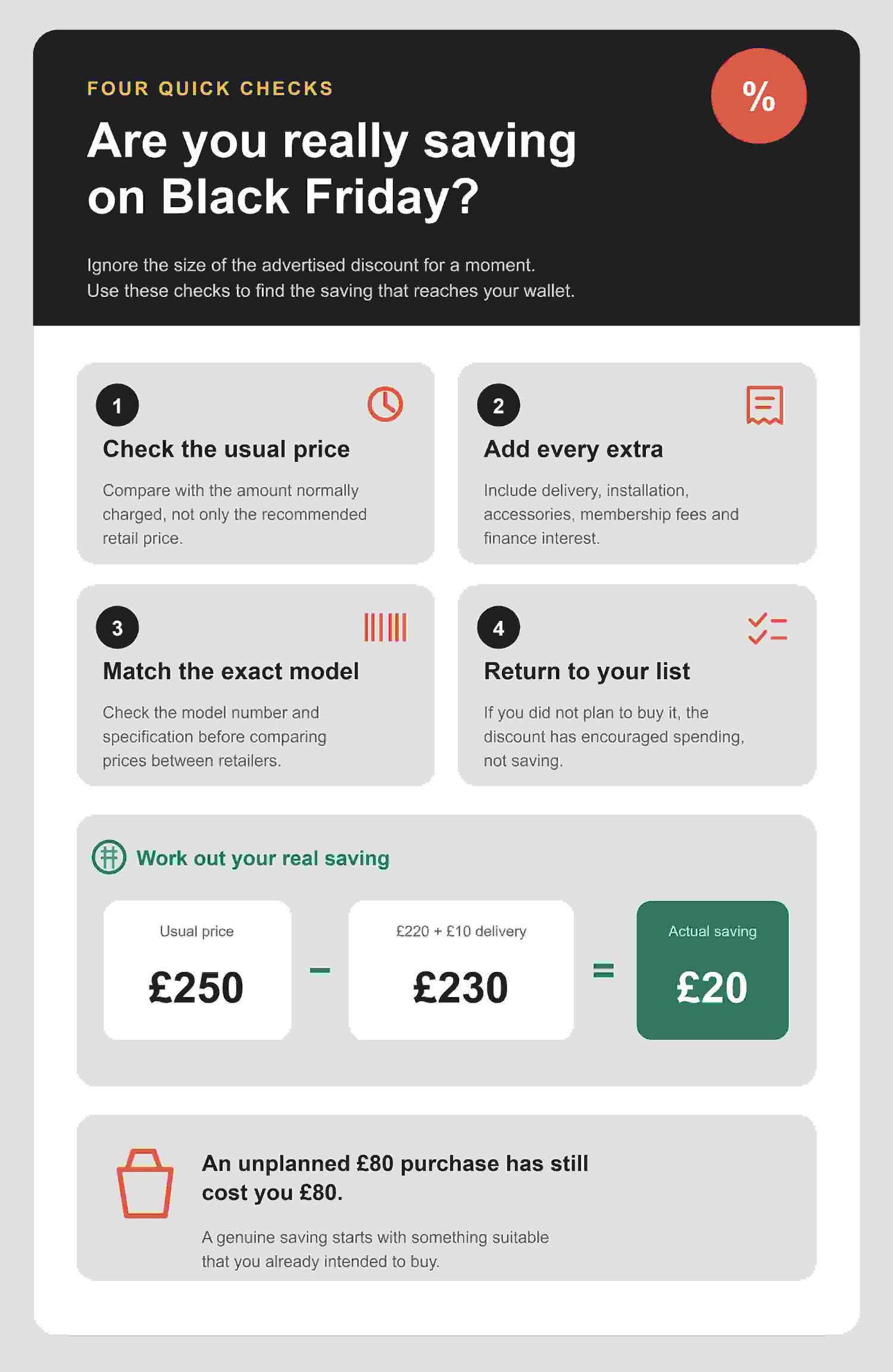
Finding a worthwhile Black Friday deal usually starts before the sale. If you wait until the offers appear and then begin browsing, the retailer controls the comparison: you see its chosen RRP, its claimed saving and its countdown clock. Preparing a shortlist gives you your own reference points.
I prefer to decide what I would buy, what specification I need and the most I am prepared to pay. That makes Black Friday less about hunting for the largest percentage and more about waiting to see whether the right product reaches the right price.
- Create a focused shopping list: Write down the products you genuinely intend to buy, including any essential sizes, features or model numbers. A large discount on an unsuitable alternative is not a better deal.
- Start a watchlist before November. Save products in your retailer accounts or use price-tracking sites to follow price changes over time. A few weeks of price history tells you more than the RRP next to a Black Friday deal. Which? also suggests making wish lists and checking price histories before the sale.
- Set a target price: Decide what would make you comfortable buying. If a £500 television reaches your £400 target, you can judge the deal on its merits instead of wondering whether an extra £10 might disappear overnight.
- Sign up selectively: Retailer newsletters, apps and loyalty schemes can provide early access, member prices or exclusive discount codes. I only sign up when I am considering a purchase from that company. Otherwise, a stream of promotional emails can create more temptation than savings.
- Prepare your account in advance: Confirm your address, preferred delivery method and login details before the busiest shopping period. This can be useful when stock is limited, and it gives you time to check for loyalty points, free member delivery or app-only offers.
- Look for compatible savings: Check whether the sale price can be combined with a voucher code, cashback offer, gift card or loyalty reward. Read the conditions carefully, as Black Friday products and existing reductions are frequently excluded from additional promotions.
- Compare the complete cost: A retailer with the lowest headline price may charge more for delivery, installation, accessories or removal of an old appliance. Compare the total at checkout rather than the product price alone.
- Keep a record of important offers: Take a screenshot of the product, price and promotional conditions when relying on cashback, a price promise or a time-limited code. It will be easier to query a missing saving if you have evidence of what was advertised.
Should you wait until Cyber Monday?
In 2026, Cyber Monday is on 30 November, three days after Black Friday. It used to be mainly for online and tech deals, but now most Black Friday offers are online and last through the weekend, so the difference isn’t as clear.
From personal experience, waiting for Cyber Monday can result in bigger savings, but it is a risky strategy. Some retailers add new online discounts or lower prices on leftover stock, but Cyber Monday doesn’t always have the best or final deals. Some stores just keep Black Friday offers going, while others end popular deals when they sell out.
You should be careful about waiting for an even bigger discount if the item you're after has reached the price you're willing to pay. The only reason for delaying your purchase is if there is a lot of stock available, you have other good options, and you are actually comfortable with the idea of missing out.
My verdict: Do you actually save on Black Friday?
Before my partner and I buy anything on Black Friday, we ask ourselves one question: would we still want it if it weren't on sale? If the answer is no, the discount is pushing us to buy something we don't really need. Generally, this question tells us more than the discount amount.
I never judge a Black Friday as a success on the basis of the amount that the receipt says I've saved. A sale has fulfilled its purpose if I replace an item that we already needed, pick the correct product and end up paying less than I had reasonably expected. However, if the deal leads me into spending £300 even though that amount was not something we had intended to spend, a ‘saving of £150’ doesn't in any way improve our bank balance.
Black Friday can be useful, but it shouldn't control your decisions. Buy when the price seems right to you, but also feel free to close the browser tab if you don't want to. The fact that you don't spend the money is a kind of saving that no store can overstate.
Frequently Asked Questions
Do the same consumer rights apply to Black Friday deals?
Yes, Black Friday deals have the same statutory protections as full-price purchases. They must be of satisfactory quality, fit for purpose and as described. According to GOV.UK, a retailer cannot refuse a refund or other appropriate remedy for faulty goods simply because they were reduced, although you cannot complain about a specific fault that was clearly disclosed before purchase.
For most online orders, you also have a 14-day cooling-off period after receiving the goods, subject to certain exceptions. If you buy in a shop and simply change your mind, however, the retailer does not normally have to accept the return unless its own policy allows it.
Is it safer to pay for Black Friday purchases by credit card?
It can be, particularly for expensive purchases. Under Section 75 of the Consumer Credit Act, a credit-card provider can share responsibility with the retailer if a single item costing more than £100 and no more than £30,000 is faulty, misrepresented or never supplied. The protection can apply even if you pay only part of the cost, such as the deposit, by credit card.
Section 75 does not cover items costing £100 or less, although your card provider may offer chargeback instead. Payment through certain third parties can also affect whether Section 75 applies. Most importantly, a credit card only provides a financial advantage if you can repay the balance in full; interest charges could quickly outweigh the money saved in the Black Friday sale.
Are Black Friday discounts still as good as they used to be?
Black Friday once looked far more dramatic in the UK. In 2014, police were called to stores as shoppers queued overnight, crowded through doors and fought over heavily reduced televisions and electronics. Those scenes were fuelled by ‘doorbuster’ promotions: a small quantity of conspicuously cheap products released in stores at a fixed time.
The deals have not gone away, but the way stores run Black Friday has changed. Now, retailers spread discounts over several weeks, so the rush does not all happen on one day.
You May Also Like

Best Affordable Father's Day Gifts
by Matt Piqué | 1/6/2026
How to Get the Cheapest Easter Eggs
by Matt Piqué | 9/3/2026
The Five Best Cheap Mother’s Day Gifts 2026
by Matt Piqué | 9/3/2026
The 24 Best Valentine's Day Gifts for 2026
by Matt Piqué | 2/2/2026