


Skiing on a Budget: What's the Best Way to Save Money on a Ski Trip?
Updated 5th March 2026
Key Takeaways
- Pick Affordable Ski Destinations: Choose lesser-known ski resorts over headline destinations to cut costs on lift passes, accommodation, and food. Smaller resorts can offer a similar on-snow experience for less.
- Cut Costs on Where You Stay: Stay in self-catering apartments, or book accommodation a little further from the lifts to avoid premium prices. Using platforms like Airbnb and Booking.com, or choosing hostels and lodges, can reduce your total spend across the trip.
- Save on Ski Gear and Lift Passes: Book ski equipment and lift passes online in advance to unlock discounts from sites like Savoo. Consider renting gear instead of buying, and look for half-day, multi-day, or area passes to reduce the per-day cost.
Skiing is hugely popular, with ESF (U.K.) estimating that over 1.5 million Brits take a ski holiday each year. However, as exciting as a ski holiday can be, it can also be expensive. Between lift passes, accommodation, flights, spending money, and lessons, costs can add up quickly.
When looking at ski trip prices, there are 4 main points to consider: travel, accommodation, ski passes, and equipment rentals. It is then a balancing act between costs to find the best option for you.
But don’t worry, there are plenty of ways to save money on a ski trip. With the right planning, you can find better value on everything from flights to equipment rental and self-catering accommodation. This guide will walk you (or maybe even ski you) through practical money-saving tips to help you get the best prices for your next ski holiday without breaking the bank.
What’s in Savoo’s guide for a cheap ski holiday
- Flight or train: what is the cheapest option for a ski trip?
- What is the best destination for an affordable ski trip?
- How to get cheap accommodation for a ski holiday?
- How to save on ski equipment and ski rentals?
- Extra tips to save money on your ski trip
- Conclusion: Cheap ski holidays made easy
Flight or train: what is the cheapest option for a ski trip?
Many airports in the U.K. offer cheap flights to the main European ski destinations, such as France, Switzerland, and Austria. You can find flights to Salzburg, Austria, from as little as £29 from London, or to Geneva, Switzerland, from £37 from Liverpool.
We’ve set March 2026 as a benchmark month, right after the school breaks, but still early enough to enjoy the slopes.
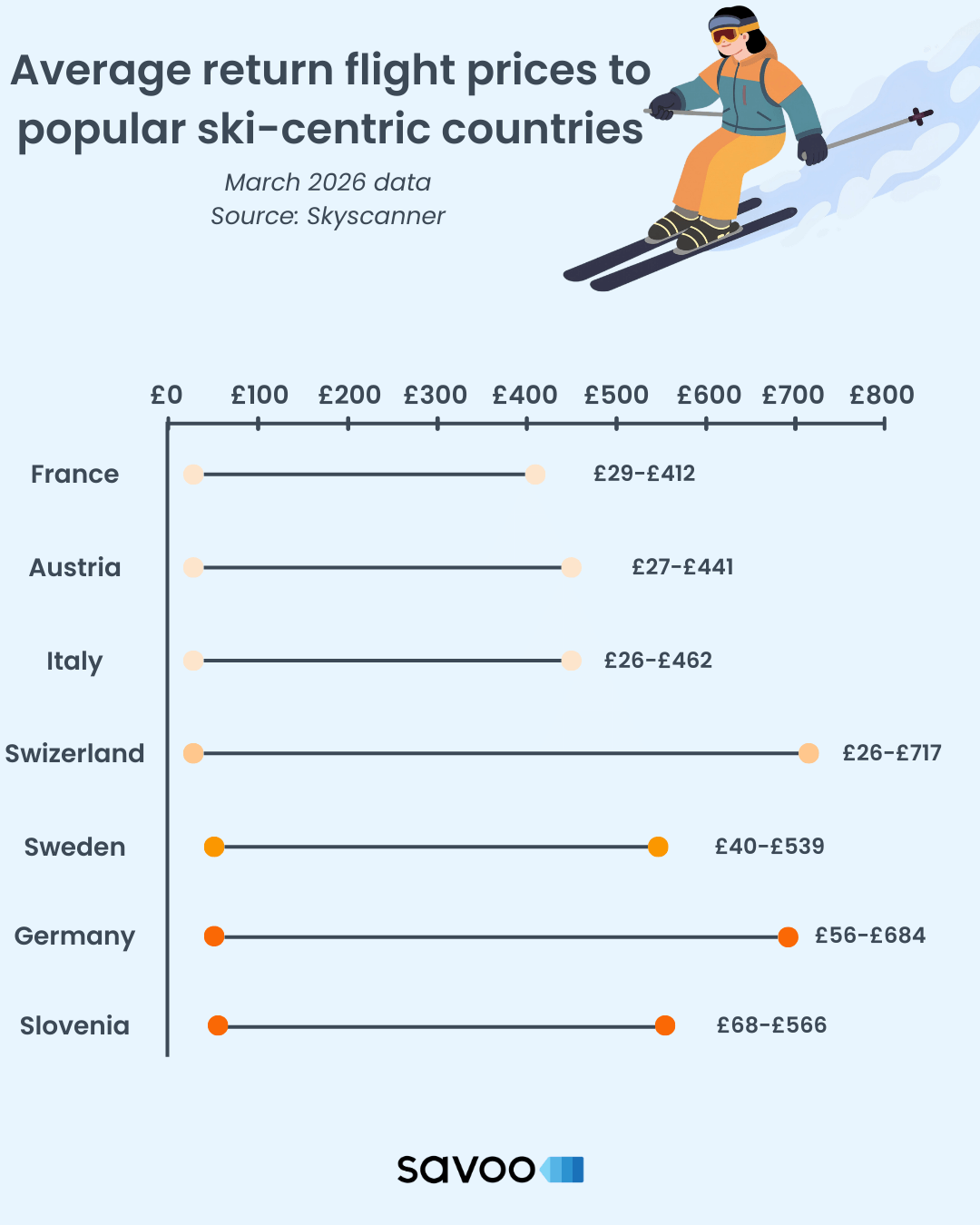
On paper, flight prices even look a bit too good to be true. And in this case, they can be, because they don’t account for luggage. A return flight from Liverpool to Geneva, set at £91 without luggage, climbs to £155 with a cabin bag and to £174 at the cheapest with a checked bag. Depending on how many of you are travelling and how long you’re staying, you need to be smart with your packing to keep the costs as low as possible. If you’re travelling with your own skis or snowboard, prices are likely to be even higher.
An alternative for some destinations is to take the train. The Eurostar takes you from London to Paris in under 2.30 hours, and by booking tickets in advance, you can find prices as low as £39 one-way. From there, the French train network takes you to the French Alps in about 4 hours, or to the eastern region of Vosges in under 3 hours, with prices starting around €35 one way (about £30). You can also find trains to Switzerland, Germany or Austria, all from Gare de l’Est or Gare du Nord in Paris, for a similar price.
Train also offers another advantage: it often removes the costs of the transfer. Train stations are usually located in the middle of the city, close to hotels and the slopes. For example, taking a train to Bourg-Saint-Maurice and a short funicular ride will take you directly to Les Arcs, whereas flying to Geneva or Chambéry will add a 2.30/3h transfer to the same ski resort, with variable prices.
Things to consider when choosing your travel option
- How many people are you travelling with? If you’re travelling with friends or family, you can maybe share a checked-in luggage to save on costs.
- How long are you staying? Travelling by train is usually longer, so you might want to prioritise flying if you’re not there for long.
Money-saving tips when choosing your travel option:
- Use a search tool like Skyscanner to make it easier to compare dates, airlines, and nearby airports.
- Book in advance to get the best prices. Eurostar tickets are available up to 8 months in advance, andSNCF (the French train network) up to 4 months in advance.
- Avoid peak days if you can. Travelling on Fridays or Saturdays is usually more expensive than on other days of the week. Same thing for school holidays, where prices usually rise.
What is the best destination for an affordable ski trip?
Destination choice is one of the biggest drivers of overall cost. France and Switzerland are often the first places people think of, but many resorts across Europe offer great slopes at better value.
Some of the most well-known ski resorts around Europe include Val d’Isère and Tignes in France, St Anton in Austria, and Zermatt in Switzerland. The only thing is, because of their popularity, they can be expensive. If you look beyond the biggest names, you can often find great places to ski without needing a ‘luxury’ budget.
For example, Skiresort publishes a price comparison of day tickets across Bulgaria, including smaller resorts such as Kartola-Momchilovtsi, Semkovo, and Vetrovala. On its comparison pages, day tickets at the lower end of the range can be around €15 (£13) a day in the main season.
By contrast, larger and better-known Bulgarian resorts such as Borovets and Bansko can be significantly higher during peak weeks. The exact price varies by date, age group, and area, so always check the resort’s official pass page before you book.
Here are some examples of cheaper alternatives to the most popular European ski resorts:
| Destination | Slopes Size | Ski Pass Price (Per Day) | Alternative | Slopes Size | Ski Pass Price (Per Day) |
|---|---|---|---|---|---|
| Morzine/Avoriaz (France/Switzerland) | 580km | €72/adult €57/child |
Bernex (France) | 19km | €29.90/adult €25/child |
| Pamporovo (Bulgaria) | 29.8km | €44.99/adult €27.10/child |
Malyovitza (Bulgaria) | 4km | €26/adult €16/child |
| Kaiser-Brixental (Austria) | 275km | €76/adult €38/child |
Karwendel Bergbahn - Pertiseau (Austria) | 12km | €35.50/adult €23/child |
| Garmisch-Partenkirchen (Germany) | 40km | €69/adult €35.50/child |
Götschen-Bischofswiesen (Germany) | 8.7km | €30/adult €17.50/child |
| Åre (Sweden) | 91km | €75/adult €60/child |
Dundret Lapland – Gällivare (Sweden) | 12km | €40/adult €32/child |
Lift tickets are a major expense on a ski holiday. Radical Storage’s analysis of 100 European resorts put the average day pass at €66.46 in 2023, and reported that prices have risen faster than inflation since 2015. Treat this as a broad benchmark: actual prices vary widely by country, resort, season, and whether you buy in advance.
'One of the easiest ways to save is by being smart about ski passes. Buying single-day lift tickets at the resort is almost always the most expensive option. Multi-day ski passes significantly lower the cost per day, and passes like the Epic Pass or Ikon Pass give you access to multiple resorts at a better rate.'
If you’re considering multi-resort passes, note that products like the Epic Pass and Ikon Pass are primarily geared towards North America, although some tiers include limited access to European partner resorts. Always check the current season’s terms, included resorts, and blackout dates before buying.
Flight prices also matter. The ski season typically runs from late November to April, but prices can vary sharply by week, especially around school holidays.
‘With such a large focus on the peak weeks of the season, it is not uncommon for operators and owners to discount weeks in January to increase occupancy. And if prices are not reduced, you may be able to benefit from various special offers such as complimentary transfers, massages, ski instruction or maybe even a helicopter tour!'
- The size of the resort. If you’re not a pro skier or a dedicated ski enthusiast, you don’t necessarily need a massive resort. Smaller resorts work perfectly for families and amateurs.
- Nearby entertainment. Maybe you won’t stay all week on the slopes and will want to treat yourself to a spa day or a mountain hike. Have a look at what activities are available near the resorts.
Money-saving tips when choosing a ski resort:
- Consider a package deal. Booking a package through Crystal Ski or TUI can sometimes be better value than booking everything separately.
- Avoid school holidays. Prices often rise during February half-term and around Christmas, so off-peak weeks in early December or later in January can be cheaper.
- Look at lesser-known resorts. Better value can often be found in smaller ski areas, including parts of Bulgaria, Germany, and beyond.
- Buy lift passes in advance. Many resorts offer early booking discounts, or lower online prices, as an enticement.
- Use multi-day discounts. Booking for multiple days can save money compared to single-day lift tickets.
- Consider half-day passes. Useful for beginners, or if you’re mixing skiing with other activities, so you only pay for the slope time you’ll actually use.
How to get cheap accommodation for a ski holiday?
Accommodation is often the biggest line item after travel. Ski-in, ski-out hotels are convenient, but they’re usually priced at a premium. Self-catering, or staying in nearby towns, can be cheaper, but factor in the time and cost of getting to and from the lifts so you don’t spend on transport what you’ve saved on the room. Especially as some hotel prices include ski passes.
Compromising a little on location or type of accommodation can make a noticeable difference. For example, in Chamonix, hotels like Heliopic Hotel & Spa can sit at the higher end of the market in peak winter weeks.
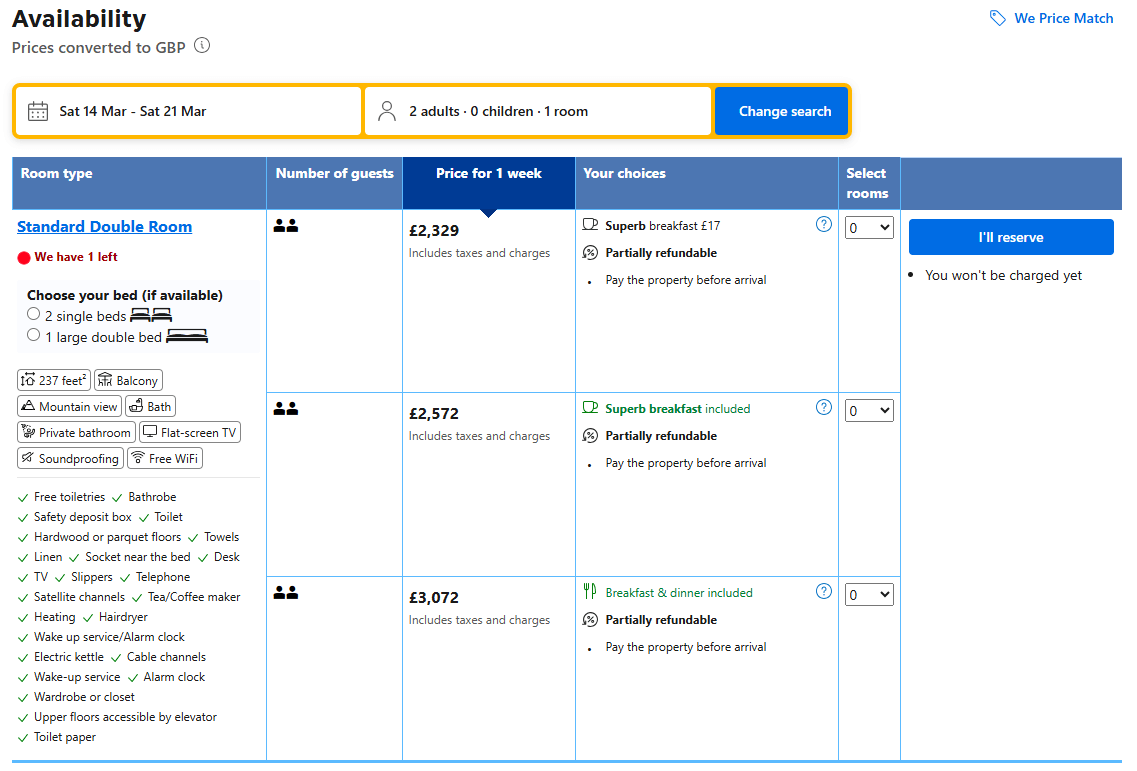
Alternatively, in the same area, self-catering apartments on Airbnb can come in almost 3 times cheaper for comparable dates, depending on size, location, and whether you book early.
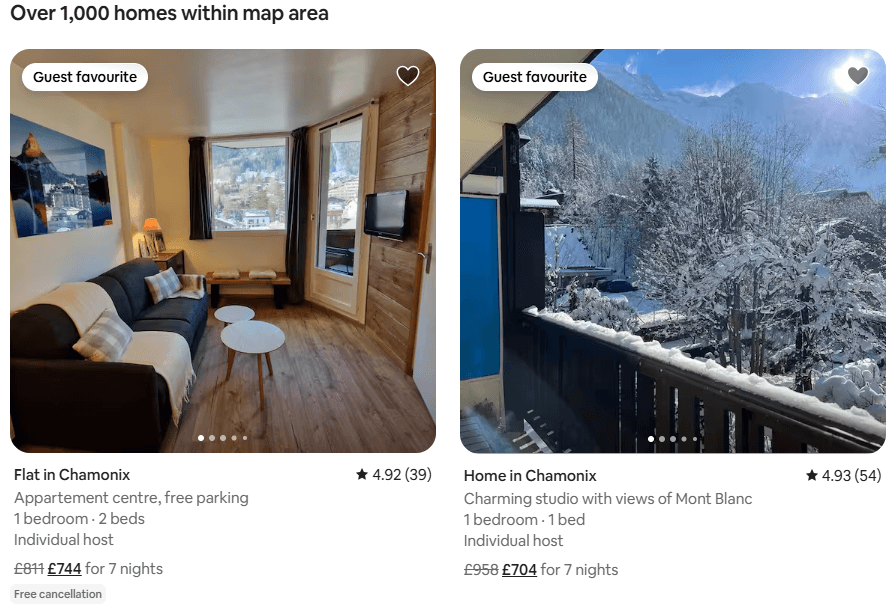
Other accommodation options are available and can drastically reduce the bill:
- Couchsurfing: If you’re a solo traveller and want to meet people, couchsurfing can be a good option. You can find rooms or convertible couches for very cheap or even for free around the world.
- Flatsharing: We tend to forget that platforms like Airbnb were created to rent rooms. Try adjusting your requirements to a single room instead of an entire home; you could knock a few hundred pounds off your budget.
- Homeswitching: You go and spend a refreshing ski trip while your host discovers the charm of the U.K. from your house. An interesting win-win situation that only costs some cleaning or insurance fees.
- Location: If you don’t intend to ski every day, you can probably stay a little further from the slopes.
- The property’s size: Let’s be real, you’ll probably spend more time outside than inside. Switching to a smaller accommodation could save you a few precious pounds.
- Your holiday type: If you’re mainly going to ski, you might not need the fancy pool-and-spa hotels, which are usually quite costly.
Money-saving tips when booking your ski accommodation:
- Share accommodation. If travelling in a large group, renting one chalet can work out cheaper than multiple hotel rooms.
- Check transfer costs. A cheaper room can look less appealing if airport transfers, taxis, or parking are expensive.
- Book early. Popular weeks sell out quickly, and late availability is often priced higher.
- Use discount codes. At Savoo, we offer discount codes for sites like Booking.com so you can make big savings.
How to save on ski equipment and rentals?
Equipment is another cost that can creep up, especially for families. Renting at the resort is convenient, but you may find better value by comparing local shops, booking online in advance, or exploring off-site options.
Average daily cost for equipment rental To give you a rough idea of prices, we’ve looked at the published rates at All Mountain Rental:- Adult ski boots: €16 (£13) a day.
- Adult skis: €22.40 (£19) a day.
- Children ski package (boots + poles + skis): 22.40€ (£19) a day.
- Snowboard boots: €16 (£13) a day.
- Adult snowboards: €31.20 (£27) a day.
- Adult helmet: €16 (£13) a day.
- Snowshoes: €11.20 (£9) a day.
- Off-piste pack (includes rucksack, transceiver, shovel, and probe): €25.60 (£21) a day.
Note: prices and ranges vary by resort, season, and equipment grade. Always check the supplier’s current list before you book.
However, many companies, like All Mountain Rental, offer lower prices when you book for several days. In this case, adult ski boots go from €16 for one day to €7/day for a 7-day rental.
'The ski equipment is pretty average, also tends to be cheaper if you book gear online in advance. Sometimes cheaper, too, if you go via a 3rd-party aggregator site. There would be dozens of options in normal-sized ski towns. Sport2000 and Intersport are big chains, and there are also local shops. Hiring in the U.K. to then go skiing in Europe would probably be counterproductive, as you likely would get lower quality gear here, given that there is no demand in the U.K., and you then have to pay extra luggage fees.'
Third-party aggregator sites are a great option to save money on your ski rental. They offer premium quality equipment with discounted prices and sometimes with voucher codes available as well. Here is a breakdown of the best features of some of the most popular rental stores:
| Skimium | Sport2000 | Netski | Intersport Rent | Skiset |
|---|---|---|---|---|
| Up to 50% cheaper than resort rentals | Group bookings available with up to 20% off | Up to 10% off with deals on average | Average 10% discount in select countries | Regular deals for up to 10% off |
| Cumulative discounts available | Deals for free ski rentals for children | Wide choice of ski & snowboard gear | Ski poles included in rental price | Stores brands like Rossignol, Atomic, Nordica… |
| Available in 6 countries (including France & Switzerland) | 600+ rental shops available in 8 countries | 140 hire shops in France, Italy, Switzerland… | 800+ locations in 14 countries | 780 stores in France, Germany, Switzerland, and more |
| Free cancellation up to 24h in advance | Free exchanges (except France & Andorra) | Free cancellation up to 24h in advance | Helmet cameras & snowbikes available at select stores | Exclusive 3D tech to find the best fit |
Money-saving tips when renting your ski equipment:
- Book in advance. Online deals can save you up to 50%. Plus, you'll save time upon arrival, as you will only need to collect your equipment.
- Don’t rent professional equipment. If you’re not a regular skier, you don’t need to rent premium equipment. It’s usually way more expensive, and you won’t get anything more out of it.
- Rent instead of buying. It can be tempting to buy your own equipment, especially if you ski regularly. But you could end up paying luggage fees, so be sure to do long-term calculations to see if it’s worth investing.
Extra tips to save money on your ski trip
Lock up your travel insurance
If you usually don’t opt for travel insurance, going on a winter sports holiday could be the time to do it. From injuries to equipment damage, there are a lot of things to take into account when you go on a ski holiday, and getting the right insurance could save you some money down the line if anything happens.
If you’re a U.K. citizen, ask for a Global Health Insurance Card (GHIC). This free insurance policy gives you access to necessary state healthcare on the same basis as a local. This includes:
- Emergency treatment and visits to emergency services
- Treatment and monitoring of pre-existing conditions
- Routine maternity care
EU nationals can access the same insurance within the EU through the European Health Insurance Card (EHIC).
In addition to health insurance, ski holiday insurance usually covers:
- The loss of your ski pass
- Damage, theft, or loss of your personal or rented equipment
- Alternative equipment in case of lost or delayed luggage
- Personal liability in case you injure someone else
- Meteorological compensation in case of slope closure due to too much/too little snow, high wind or avalanche alerts
- Delayed due to an avalanche
Check sites like Compare the Market to compare insurance prices, or check if your work benefits cover a travel insurance plan.
‘The insurance you’re offered when buying your ski pass is generally already covered by your own travel insurance. Check all the details thoroughly to avoid paying twice for the same service.
And when renting your ski equipment, check if they reimburse you for the unused days in case of an accident.’
Budget your ski-trip
As usual, the best way to save money is to plan the money you’re going to spend. Food can represent a big portion of your budget, with delicious restaurants and “après ski" drinks.
Start looking at restaurants before your trip. Use social media to research hidden gems and cheap recommendations. You can also use websites like The Fork to get great deals on restaurants and save up to 50% on your meal.
If you know you’ll be cooking, try bringing some cheap basics from home. Supermarkets and convenience stores near the slopes may charge higher prices for kitchen essentials such as pasta, rice, and cereals. Bringing a family pack of penne, a few tea bags or some Witabix can go a long way. If buying in local supermarkets, try to choose store-brand products.
As a rule, bring a packed lunch. Mountain restaurants can be pricey and not that nice. It will not be a sustainable option for your budget. Instead, bring your own picnic and treat yourself to a nice restaurant a few times in your trip.
Don’t forget banking and roaming
Avoid exchange rates and fees with online banking. Banks like Revolut let you open a European bank account, giving you a bank card you can use for free abroad. You can transfer your money directly to your account and only use this card to avoid extra fees. Note that many places in Europe are not cashless, quite the opposite! Some places won’t accept card payment under a certain amount, so remember to carry €10-20 just in case.
Check your roaming options before going. Since Brexit, using your phone abroad can be a bit trickier. To avoid additional costs, see what you can unlock with your provider. You can also pay for an e-SIM with sites like Saily, which will give you data for a set amount of time at a low price.
Conclusion: Cheap ski holidays made easy
With a bit of planning, skiing doesn’t have to cost a fortune. Start with the highest costs first, then work down to the smaller savings, because they add up. For more travel timing advice, see our guide on when is the best time to book a holiday.
Ready to book your next ski holiday? Here at Savoo, our up-to-date voucher codes help you save money at retailers, sports equipment, and travel companies, like Expedia, Trainline, Jet2holidays, and more. And finally, if you decide skiing is not for you after all, check out our top 10 cheapest holiday destinations abroad for getaway inspiration.
*All information, including prices and exchange rates, is correct at the time of publication.
You May Also Like

Ways to Save Money at the Edinburgh Fringe
by John Connellan | 2/8/2026
How to Save Money on Travel Insurance
by John Connellan | 4/5/2026
Get discounts at these popular retailers with our voucher codes and promo codes
- MedExpress
- Pets at Home
- MuscleFood
- early learning centre
- MyHeritage
- Roman
- QVC
- Disney Store
- AliExpress
- Virgin Experience Days
- Jacamo
- G Adventures
- iHerb
- iScooter
- P&O Ferries
- Argos
- John Lewis
- Debenhams
- TUI
- Marks & Spencer
- SHEIN
- Very
- Buyagift
- Zavvi
- First Choice
- Dorothy Perkins
- New Look
- Karen Millen
- Footasylum
- Clarks
- H Samuel
- Ernest Jones
- Tesco
- Sainsbury's
- Interflora
- Hotel Chocolat
- Boots
- Holland and Barrett
- LOOKFANTASTIC
- The Body Shop
- B&Q
- Wickes
- Dunelm
- ao.com
- Currys
- Nike.com
- SPORTS DIRECT
- Halfords
- Myprotein
- Domino's
- boohoo
- Missguided
- HP
- Sky
- BT Broadband
- Travelodge
- lastminute
- Bulk
- Samsung
- Booking.com
- Boomf
- In The Style
- Pizza Hut
- Ted Baker
- Hive Home
- Omio
- Mindful Chef
- Amazon
- Amazon Prime Free Trial
- VonHaus
- Gtech
- BAM
- Home Essentials
- Alienware
- Gousto
- Moonpig
- Pandora
- Papa John's
- Toolstation
- eBay
- NordicTrack
- Bloom and Wild
- Asos
- Superdrug
- JD Sports
- Temu