


New Year’s Resolutions That You Can Stick To - And They’re Free!
When January 1st rolls around, many of us take it as an opportunity to make a fresh start and either begin or stop doing something in the search for self-improvement. But, did you know that 80% of people fail their New Year’s resolutions by February? This is often because we set our sights too high, underestimate the cost, or try to change too much at once. Cold-turkey attempts to eat healthily or stop smoking can feel overwhelming, and many people repeat the same resolution year after year, which quickly becomes frustrating. And January is already a notoriously tricky month that just so happens to be the home of Blue Monday, the saddest day of the year, which definitely doesn't help with getting into a positive headspace.
Christine Schneider, founder of the Cambridge Therapy Centre, explains:
"The start of a new year often feels like a symbolic fresh start, but this can lead to overly ambitious resolutions that are difficult to sustain. Many people try to make sweeping changes all at once, which can feel overwhelming as the January excitement fades. Others set vague goals like 'be healthier' or 'save more money', which lack the structure needed to guide meaningful progress."
If you like to set a New Year’s resolution, what sort of promise can you make to yourself that you can realistically stick to, without money getting in the way? Below, we run through low-cost and free New Year’s resolutions you can maintain, so you start the year feeling positive rather than pressured.
9 New Year’s resolutions you can keep
Fed up with setting yourself a New Year’s resolution only to stumble at the first hurdle? It does not have to be as difficult as it sometimes feels, especially if money is not a worry. Here are 9 cheap and free New Year’s resolution ideas that are realistic and sustainable.
1. Create a routine that works for you
Many New Year’s resolutions fail because they do not fit into existing routines. A practical resolution can be to adjust your routine itself. This does not need to be a grand gesture. Small changes, such as setting your alarm 15 minutes earlier to eat breakfast or adding a short mindfulness session to your day to ease stress and anxiety, can make a real difference. The smaller the change, the easier it is to maintain. Best of all, these tweaks cost nothing.
2. Set a micro-goal
Big, life-changing resolutions can be motivating, but they are often hard to achieve. Instead of broad goals like ‘walk 10,000 steps a day’, try micro-goals such as ‘walk for 10 minutes every day’ or ‘drink one extra glass of water’. These goals may seem modest, but they are far easier to build into a busy routine.
If your aim is weight loss, avoid setting a single, intimidating target. Smaller, clearly defined goals are more manageable than vague intentions like ‘lose weight’.
Sam Coombes, founder of TwinFit PT, explains how small steps add up:
"I always want my clients to focus on small weight adjustments, week by week. Having a laser focus on building consistent habits pays huge dividends in the long run. Forget the aim of losing 4lbs a month - focus on 1lb a week. This shift in mindset can make a huge difference."
A simple financial micro-goal is saving a small amount each month. For example, putting aside £20 on payday adds up to £240 over a year. This could be used for Christmas spending or added to an emergency fund. If you prefer a digital approach, there are also money-saving apps that automate the process.
3. Focus on your mental health
Looking after your mental health is one of the most valuable resolutions you can make. You do not need to overhaul your life. Small actions such as journalling for 10 minutes, taking regular breaks, going for a walk, talking to a therapist or taking time out to stroke your cat in the middle of the day can support your well-being. Many of these options are free or low-cost and help build resilience. If being more active is part of your plan, you can also learn how to save money on gym memberships and fitness classes.
4. Learn something new
Your resolution does not have to focus on self-improvement alone. Learning something new can be just as rewarding. This does not need to be a major commitment like mastering a language or writing a book. Small, enjoyable skills can be just as fulfilling.
Learning to juggle, paint, or cook, are good examples. These activities allow gradual progress without pressure and offer a clear sense of achievement. To keep costs down, you can look for deals and voucher codes for retailers such as HobbyCraft when buying supplies.
Whether you’re looking into expanding your skill set or enriching your general knowledge, you can always count on social media to learn new things for free. From makeup and DIYs to cooking and history, you’ll find countless hours of free materials to expand your horizon this year.
5. Declutter your space
Decluttering can feel daunting, but it is one of the most achievable resolutions. Rather than reorganising everything at once, start small. This might mean clearing a desk, a drawer, or a cupboard.
As you build momentum, you can move on to larger areas such as a spare room or loft. Selling or donating unused items frees up space and can even generate a little extra cash. Online shops like Vestiaire Collective for fashion, or eBay for everything from tech to home, allow you to sell your items very easily. Even modest decluttering can provide a noticeable boost to mental health.
6. Work on your relationships
Most of us let relationships slide from time to time. Busy schedules mean messages go unanswered, or plans get postponed.
A simple resolution is to check in with people more regularly. Setting a reminder to send a quick message or reply to one you have missed can strengthen connections. Small gestures often matter most.
If you want to meet up, arranging a meal or coffee does not have to be expensive. Using a voucher code at restaurants such as Frankie & Benny’s can help keep costs down.
7. Limit your screen time
With constant access to social media, messages, and entertainment, it is easy to spend more time on your phone than intended. Social media doom-scrolling, games, reels, WhatsApp… there are so many things to check, it’s no wonder Brits spend almost four hours a day on their phones.
Cutting screen time completely is unrealistic, but small reductions add up. Reducing usage by even a quarter can free up around an hour a day. This time can be spent on other goals, such as learning something new or connecting with others.
A practical place to start is bedtime. Try avoiding your phone once it is plugged in to charge. You could even go the extra mile and invest in an analog alarm clock to avoid bring your phone in the bedroom. You can find some as low as £6 at Argos!
Monitoring your usage and setting small limits can also help reduce impulse spending, which often happens during idle scrolling. Data shows that almost half of us spend money while browsing our phones at work. So if you at least limit your browsing during the day, you’ll save by limiting those impulse buys.
8. Give something back
Giving back is a resolution that benefits both you and others. This does not have to involve donating money. Volunteering your time, even occasionally, can be just as meaningful.
Simple actions like picking up litter during a walk or helping at a local community project allow you to contribute without a long-term commitment.
With Raise & Save, Savoo offers you a unique way to support various charities like Marie Curie, Blue Cross, or Save the Children. Create your free account and pick the charity you want to support. Each time you use one of Savoo’s discount codes or deals, you’ll earn donations for your selected charity, at no extra cost for you!
9. Be kind to yourself
Sometimes the most important resolution is being kinder to yourself. This means allowing for mistakes, recognising effort, and celebrating progress.
Self-criticism is common, but it rarely helps. Practising self-compassion and acknowledging small wins supports better mental health. Best of all, it costs nothing, unless you choose to treat yourself occasionally, which is perfectly fine too.
How to stick to your New Year’s resolutions
Now that you have an idea of your goals for the year, here are a few methods to help you stick to your resolutions this year.
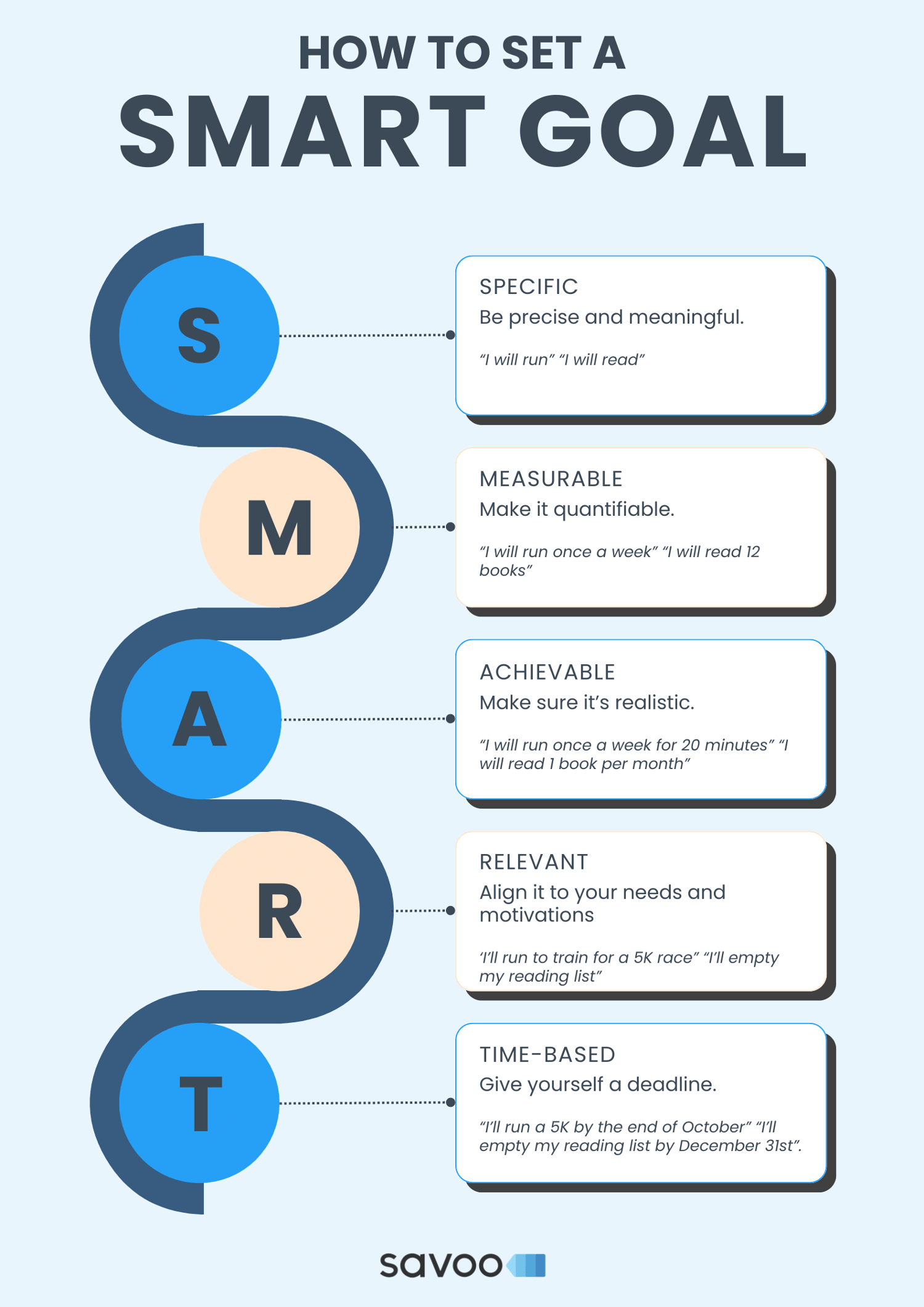
- Make your goals SMART: Specific, Measurable, Achievable, Relevant, and Time-Bound goals (or SMART goals) provide a roadmap to help you keep your objectives and ensure they're attainable. For example, “I want to read 2 books from my reading list per month" instead of “I want to read more", or I want to run my first 5K by the end of October" instead of “I want to run a marathon" if you’ve never run before.
- Choose goals that are relevant to you: Out with the “I should"; go for the “I want"! Goals and resolutions are more appealing if you’re doing them for yourself, because you really want to, not because you feel pressured to by society, social media, or friends and family. You’ll be way more likely to succeed if you pick things you really enjoy and feel motivated by.
- Incorporate one new habit at a time: Studies show that new habits take around 66 days to form. If you start implementing all of your resolutions at once from January 1st, odds are you’ll become overwhelmed very quickly and drop most, if not all, of them. So start with one resolution for a couple of months, and then add a new one to the mix. It’ll allow you to include them mindfully into your routine and stabilise your everyday life before shaking it up again.
- Divide into small steps: Some goals require a little research and planning, especially if you’re making several adjustments to your everyday life. Breaking them into smaller steps will help you figure out how to make them work and keep your motivation high. Make sure you know how to walk before you start running!
- Replace old habits with new ones: We all know it, old habits die hard. If you find it hard to let go of some of them, try to replace them with new ones. For example, if you want to eat less sugar, start by eating a fruit with your regular sweet treat so your brain can start associating the two. Then you can slowly remove the sweet treat and embed your new habit in your brain.
- Be gentle with yourself: New Year’s resolutions are supposed to be a fun and creative way to challenge yourself, not make your life miserable. Try to be kind to yourself, count your wins as much as your fails, and remember that missing one day doesn’t mean the all thing is ruined!
Spend less this year with help from Savoo
New Year’s resolutions often fail because they involve big, expensive changes that are hard to maintain. Smaller, low-cost adjustments make progress easier to see and sustain.
Making small changes to your spending habits can support your goals. Savoo offers up-to-date voucher codes for a wide range of retailers, helping you save money while sticking to your resolutions. Popular options include Asda, Gousto, Iceland, Sports Direct, Uswitch, and Ninja Kitchen.
You May Also Like

50 Frugal Living Tips To Help You Save
by Ed Fleming | 25/4/2025
How to start a side hustle
by Matt Piqué | 18/3/2025
How To Live A Luxury Lifestyle On A Budget
by Matt Jones | 17/2/2025
Get discounts at these popular retailers with our voucher codes and promo codes
- MedExpress
- Pets at Home
- MuscleFood
- early learning centre
- MyHeritage
- Roman
- QVC
- Disney Store
- AliExpress
- Virgin Experience Days
- Jacamo
- G Adventures
- iHerb
- iScooter
- P&O Ferries
- Argos
- John Lewis
- Debenhams
- TUI
- Marks & Spencer
- SHEIN
- Very
- Buyagift
- Zavvi
- First Choice
- Dorothy Perkins
- New Look
- Karen Millen
- Footasylum
- Clarks
- H Samuel
- Ernest Jones
- Tesco
- Sainsbury's
- Interflora
- Hotel Chocolat
- Boots
- Holland and Barrett
- LOOKFANTASTIC
- The Body Shop
- B&Q
- Wickes
- Dunelm
- ao.com
- Currys
- Nike.com
- SPORTS DIRECT
- Halfords
- Myprotein
- Domino's
- boohoo
- Missguided
- HP
- Sky
- BT Broadband
- Travelodge
- lastminute
- Bulk
- Samsung
- Booking.com
- Boomf
- In The Style
- Pizza Hut
- Ted Baker
- Hive Home
- Omio
- Mindful Chef
- Amazon
- Amazon Prime Free Trial
- VonHaus
- Gtech
- BAM
- Home Essentials
- Alienware
- Gousto
- Moonpig
- Pandora
- Papa John's
- Toolstation
- eBay
- NordicTrack
- Bloom and Wild
- Asos
- Superdrug
- JD Sports
- Temu